Wednesday, 17 June 2015

Backpack back track

On my first Kilimanjaro climb, I carried the suggested day pack which included a lot of things.... The thing is if you don't have the backpack you may need something.  If you do have it you might overfill it...

The suggested day pack inclusions should be as follows:

Hydration Pack
Rain Jacket
Rain Pants
Camera
Snacks
Extra Water Bottle
Medication
Hat
Sunblock
Vaseline

I had a smaller day pack and it was heavy.  So next time I will rather carry a hydration pack and a moon bag.


In the rain forest, I will wear very thin gym clothes that can dry quickly if it rains.  Then I don't have to carry a rain jacket or rain pants on day one. I would rather pay an extra porter who must walk close to me in case I need to take out a full set of clothes.  I will share the porter with my travel buddies so that he can carry a full-size backpack with our extra stuff.

You really don't want to carry a lot of extra stuff.  The walk is tough enough as it is.

I will also not carry a lot of extra snacks... I will make sure I eat a fatty protein breakfast.  I will request a boiled egg to last me until lunch.  I will however still down a bottle of Rehadrat Sport before I start each day.

The moon bag (or fanny pack as some people refer to it) should be big enough for my phone (which doubles as a camera) vaseline, sun block, buff and thin gloves.

I used my hiking poles all the time so there is no need to store them or hook them to a backpack.  On my new hydration pack, there are enough bungee cords to fasten poles if need be...

One is not allowed to take any disposable plastic water bottles up the mountain but find a soft plastic one.  Or maybe a silicone one.


Saturday, 13 June 2015

I didn’t think I could do it

A short list of things I never thought I would be able to do

Climbing Mount Kilimanjaro

When my friends and I were sitting around one evening with too much wine in hand somebody mentioned that we should do something exciting.  We should climb Mount Kilimanjaro.  Of course, I said yes!  I had too much wine at that point.  I didn’t really think that I would ever do something that extreme.  But in the back of my mind I knew that if I said I would do something, I would.  Even if I had to almost die!  This big decision came about a year and a half before the actual time.  I had a lot of time to mentally and physically prepare.  I did it and I didn’t ever think I could.

Using the bushes as a toilet

I remember as a child we travelled to the coast each school break we had.  One year during the winter break it snowed on the road.  Snow in South Africa is rare so you can just imagine the excitement.  A truck skid of the road and caused a 7-hour delay on the highway.  In the 1980’s there was no real roadside convenience…  So if you had to pee you had to use the road.  I had never used nature as a toilet.  And I wasn’t planning on it.  I remember that my sister took the plunge but I just held on.  On Kilimanjaro there are toilets.  At the camps yes.  On the path no.  So here I went on this journey, never used the bush as a toilet and facing a week of outside loo breaks.  I did it!  It was easier to use the bush than using the camp facilities.  It was cleaner too.  Today I am I cured of my fear of using the bush as a toilet and can thank Kili for it!


Wednesday, 10 June 2015

Charging on top of the world

I am the type of person who is really attached to my phone.  My phone is my world.  Camera, messaging, coolness and Facebook.  Naturally, I was worried that I could not use my phone on top of the world.  But a lot of people say that there is very good signal on the roof of Africa!

When I started this whole journey may aim was to let everybody know what was going on.  I planned it all out.  I would post on Facebook as much as possible - or as long as my battery would last.  I bought a solar panel to charge my phone and camera.  I even got a chargeable battery in case there was not enough light to charge directly from the solar panel.


When arriving in Moshi I took a stroll to the nearest cell phone (mobile) shop.  I purchased a pay-as-you-go sim card which was valid for a month.  It had unlimited data and an amount for calls and text pre-loaded.  I think it cost around R100 or something.

My plan was to write an update each day and post on Facebook and send updates via WhatsApp.  It turned out that sending stuff home via WhatsApp and asking them to post on Facebook was much quicker.  So tip number one I would say is to consider the posting carefully :)

Once we started our journey up the mountain I felt like I had to document each moment.  Subsequently, I probably missed out on a few things...  In most of the pics, I am standing with the stupid cell phone in my hand!!

Tip number 2 would be to put my phone on aeroplane mode and only switch the aeroplane mode off once in camp.  It saves on battery life while making it possible to take pics and make notes.

Once we got to the summit the only thing that still worked was my phone.  Probably because it was close to my body.  The GoPro died just after the summit - so I could at least make a short video clip with that.

The solar panel worked very well.  It was compact and light weight.  Just a pity that more people used it than I did.  My suggestion is to ban all cell phones in your group and just have 1 person doing the documentation.

Bottom line, signal is ok.  Not great but ok.  It's very easy to get a local sim card.  Data is cheap.  If you wanted to you could make a call on the roof of Africa.  Leave your expensive stuff at home - they are bound to get damaged.  My poor chargeable battery got knocked around by somebody or something.

The professional cameras are hard to charge.  They have specific batteries.  Small digital cameras charge easier.  I would say leave all of that (unless you are a professional photographer and you have a few extra external batteries) and use your smartphone.  It will take great pictures and you can keep it close to your body, making it last up to the summit.  According to the experts, it is the cold that makes the battery die.

When I go again in 2016, I will definitely not be posting each and every day.  I will make notes in the evening before bed and I will rather focus on taking more awesome pictures.

www.africanreignsafaris.com

Wednesday, 21 January 2015

Climbing on the Banting Wagon

I can’t emphasise how important your meals are during your climb up the highest freestanding mountain in the world.  I didn’t really know what to expect from the meals on the mountain but they all serve the same menu.  Eggs and sausages fried in oil with toast and tomatoes in the morning.  Lunch is soup, saucy veg and fruit.  Dinner is saucy veg, soup and either chicken or beef in more sauce.  Every meal was variations of the same foods.  There is always a fruit of some kind and now and then popcorn as a snack.  It was delicious.  Each and every bite.  I forced myself to have a tea before a meal and a milo after a meal, even if I didn’t feel like anything more.  I was, however, starving during the summit.  They give you dinner before you go to bed and when you get up at 23:00 and start walking at 24:00 you only get sugary biscuits and tea.  I would have loved 4 boiled eggs for the road and would have even had canned viennas.

For snacks on the road, I took a few things from home.  Nut mix that we made ourselves… it included raisins, peanuts, seeds, dried berries and pecan nuts.  I also took small Bar Ones (chocolate bars) and Wine Gums (glucose sweets) for each day.  Super Cs (energy sweets) also did the trick.  My mother was awesome and sent Droeë Wors along and that definitely saved my hunger pains during the summit.  (Droeë Wors is a South African speciality).  The one essential thing for me was a Rehidrat Sport in the morning and in the evening.  This is a powder mixed with water that sportsmen and women drink to rehydrate after physical activity.  It replenishes the minerals used during activity.  So they say…

I can’t help but think that we would have done even better if we followed the Banting diet, which is a ketogenic diet with high fat and no carbs.  I realised this only recently after reading about the diet and watching endless YouTube Videos.  It seems that fat keeps you full for longer and that the slow release of energy is beneficial during a climb at altitude.

Watch this lecture by Tim Noakes, South Africa’s Dr Oz of the nutrition world. 

It will be difficult to explain to mountain chefs that you want a ketogenic menu but ask them not to take up bread or sugar.  Ask them to make eggs and bacon in butter – not oil.  They might still do what they have been trained to do so it will be up to YOU not to eat bread or sugar. 
Your snacks should be Biltong with fat (Beef Jerky) – South African Biltong is the best in the world by the way… include Droeë Wors (if you can’t find it take Italian sausages) and try not to take any sweets.  You won’t need it.  Focus on Almonds, Macadamia Nuts, Pecan Nuts, Pine Nuts and Pumpkin Seeds.  Unfortunately travelling with fresh produce is problematic so vacuum seal EVERYTHING.  Sniffer dogs are very sharp at the airport in Johannesburg!

I’m certainly not a nutrition expert and suggested the diet to my diabetic father.  He has been following a normal “healthy” diet since he had a stroke in 1991.  This consisted of low-fat everything, margarine, diet coke, brown bread, brown rice and no fat.  His diabetes caused him to lose a toe and now has a permanent swollen lower leg at the age of 69.  He did not really want to change his habits but watched a few videos and decided to cut out starch completely.  He had already cut out sugar since learning of his diabetes a few years prior.  On day 2 of his no starch diet, he saw an improvement in his energy levels.  He wasn’t tired after breakfast and he didn’t feel like snacking during the day.  Now he needs to up his fat intake!  Butter butter butter!!  Tim Noakes refers to a “chop” in his video… a Lamb Chop is the ultimate barbeque treat, especially with the fatty part.  For years we have been taught that the fat is BAD.  Now, at last, we can have as much of it as we want!  It will take time for us to get used to the high-fat diet as we have been brainwashed for years that fat will cause death.  What can we lose… according to the experts, we are all dying anyway, this may cause us to live a bit longer and to enjoy the food we cook… we don’t have to settle for low-fat anything!

Read more about the diet on www.realmealrevolution.com


Tuesday, 6 January 2015

These boots are made for walking

Hiking boots are probably the most important thing during your climb up Mount Kilimanjaro.  In South Africa, we don't really get a wide range of snow boots.  Our weather is pretty mild in comparison with the Northern Hemisphere.

When I started preparation for this adventure, I tried on ONLY 2 pairs of boots.  I don't know why... I mean there are so many boots on sale and I just looked at 2 different ones.

Firstly I believe that the boot needs to be high.  It protects your ankles (the last thing you need is a sprain or strain on the highest free-standing mountain in the world) and it keeps you warm.  Secondly, the shoe needs to be waterproof.  Not water resistant, WATERPROOF.  The other thing you don't want is a boot soaked in water.  They don't dry out - even in normal weather let alone freezing temperatures. Thirdly they should have soles that are tough and can grip successfully.  You will spend 6 to 8 days on your feet so the soles need to be strong enough for you not to feel each and every small rock after 2 hours.  Gripping is important especially on the way down. Finally, I believe that boots need to be light weight.  Each kilogramme you have to lift feels like ten at low altitude.

Cape Union Mart had a few options to choose from however at the moment (Dec 2014/Jan 2015) they only have 1 men's boot that may be able to do the job.  And not even the staff is convinced.  Let's hold thumbs that their new stock will arrive soon!

I went for this one.  The Salomon COSMIC 4D 2 GTX®

This is the men's version and I took a size larger than I usually wear.  You don't need to wear these in like in the old days.  If you buy them the day before you start your climb you will be able to climb without issues.  This make of shoe is small.  So if you have a wide foot or high bridge it is not for you.  That's why you need to try on a few.

They did a really good job.  This is them after the climb. I replaced the laces with elastic laces.  Too many people spoke of fingers not being able to lace boots because of cold so I went for an elastic. My feet were so ice cold during the summit.  So I don't think this boot will do in colder temperatures.

I think if it rained then I would have had wet shoes.  They say that they are waterproof but I am not convinced.  I didn't test water on them though...  I did not have any blisters and only my toes were a bit sore on the last day.  My socks were too tight.

In future, I may think about Keen boots.  They are wider and warmer.

I am sure there are many boot options to go for. Just try them all on and think about them being warm and waterproof.  It is a pity you can't take them back if you test them in water :)

www.africanreignsafaris.com


Monday, 5 January 2015

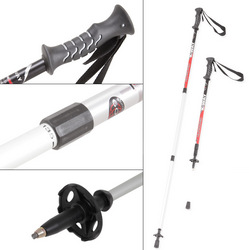
Are Hiking Poles Really Necessary?

I didn't read too much about hiking poles before we left other than looking at prices online.  The marketers that sell tours and get kick backs from certain famous shops like to try and punt all the unnecessary gear... And I thought poles were a bit overkill.

I saw pics of people hiking with just one pole which had a handle much the same as a normal walking stick or cane.  I had a look at the different ones available in stores and they all seemed the same.  Retractable shaft and wrist straps were standard.  All had protective rubbers on their ends and most had a little round "thingy" that I didn't know much about.  OK, I didn't know anything about it.

Turns out I left my job for a new one and the farewell gift were 2 K-Way Kilimanjaro Hiking poles from Cape Union Mart.  Yeah! Something I thought I didn't really need which I got as a gift.

K-Way, Hiking Poles, Kilimanjaro

My hiking buddies said: "you need to practice with those". So, off I went, hiking poles ready.  Man what an effort.  They are either in the way or too long or the terrain is too rocky... so I decided to take them to Tanzania with me and NOT to practice with them.

Unknown to most the rubber is not meant for rocky terrain but to protect the inside of your bags during the flight.  They fit into the duffel bag easily and I held thumbs that the airline staff would not force my bag into a funny position for them to be destroyed!  On arrival, they were fine and so was my bag...

On day one I had them ready.  I even fixed a GoPro to the handle in case I only wanted to use it as a monopod or extension pole.  I found out that even a GoPro is heavy and I had to swap sides every day.

hiking poles, Kilimanjaro

On day one the climb was already a challenge.  Thank goodness for these poles!  When walking they take off around 7 kg off your feet.  You get to lean forward when it really gets tough and they help you up the uphill parts when your legs can't do the work anymore.

I have to say the hiking poles are a must!  And even if you decide not to walk with them from day one, you will definitely need them on summit night.  That's when I leaned on them the most!

A tip is to adjust them once to the desired length and keep them that way.  They may freeze if you retract them before summit... Mine were quite long as I am tall so that I could pull my feet off the ground.

Even on the downhill, they helped a lot.  The ground is slippery at times and a hiking pole can assist when there are no branches or trees to grab onto.

Yes they make you walk slower and yes at times they are in the way but you walk slowly on Kili anyway...

If you plan to climb just one mountain, get the cheaper hiking poles.  Be aware though, they may not last the trip...

Tuesday, 9 September 2014

Why so much water?


The so called experts advise drinking a lot of water during your climb. But I really couldn't understand how that would help me. I mean I don't drink a lot of water during the day and only have a sip now and then during a training hike.

And who wants to stop for n pee break every hour. Because I have noticed that if I don't sweat, I pee a lot ;) 

Taking a whole hydration system to climb Kilimanjaro felt a bit extreme but I suppose there is a good reason for it...  I only realised this on the way down!

Drinking water helps to hydrate the lungs and brain. Your body is an engine and mostly comprises of water. The air is so dry that snow evaporates rather than melts. Drink water to keep your engine running!

I love this pack from K-Way. It takes a 2l hydration bladder and has some space for n rain jacket. Although a day pack is advised for climbing Kili, next time I will summit with only water and pay a porter extra to walk with my and carry clothes that I may want to take off. 


This pack is available at Cape Union Mart for R499. It does not include the bladder. I also needed to snip off a section of the pipe - it was a bit long. Luckily the nozzle squeezes back easily.

#k-way #capeunionmart #geartesting